The Transition from Old Space to New Space
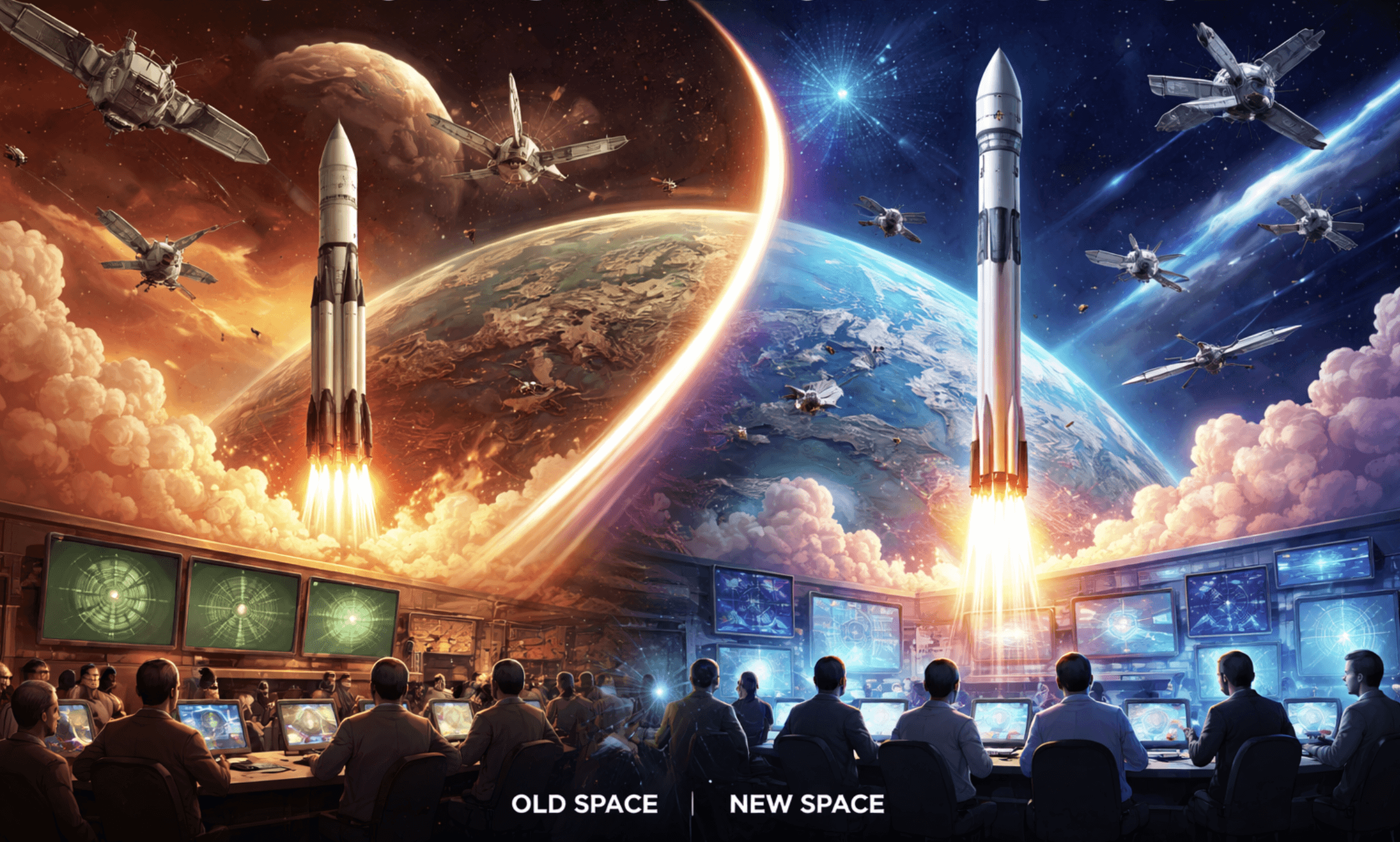
The Transition from Old Space to New Space
As Marshall notes, humanity’s relationship with outer space has undergone several distinct phases: first as a realm shaping mythological and religious worldviews, then as a strategic arena during the Cold War space race, and finally as a domain of economic opportunity and geopolitical competition—an era he describes as astropolitics (Marshall, 2024, p. 23). This compressed historical narrative captures the essential transformation in the societal perception of space. While Marshall emphasizes humanity’s enduring fascination with the cosmos, a factor that still motivates prominent commercial space entrepreneurs such as Elon Musk and Jeff Bezos (Stadler, 2022), this paper focuses instead on the political developments in the United States that were instrumental in the emergence of today’s dominant commercial space sector.
The decisive turning point in space policy occurred during the Cold War, when the Soviet Union successfully launched Sputnik 1, the world’s first artificial satellite, into Earth orbit. This event was widely perceived in the United States as both a technological and strategic triumph for Moscow, triggering profound security concerns (Lule, 1991). The so-called Sputnik shock unsettled Western intelligence agencies and media alike, as it signaled not only Soviet technological superiority but also the potential reach of intercontinental ballistic missiles capable of delivering nuclear warheads over vast distances (ESA, 2017). Under this pressure, the U.S. government responded swiftly: in 1958, President Dwight D. Eisenhower established the National Aeronautics and Space Administration as a centralized civilian space agency (NASA, 2023).
The founding of NASA was therefore not merely a defensive reaction to Soviet achievements, but also an ideological statement intended to demonstrate U.S. leadership in science, technology, and exploration (Neuneck, 2022). The ensuing decades were characterized by state-dominated, highly expensive space programs closely intertwined with geopolitical rivalry and military competition. Space activities during this period—often referred to retrospectively as Old Space—were marked by limited competition, vertically integrated state structures, and minimal concern for economic efficiency.
With the end of the Cold War, the political and military pressures that had previously driven the space race largely dissipated. At the same time, space activities became increasingly internationalized, and the United States began to critically reassess the sustainability of its massive national space budget. Rocket launches remained extremely costly and time-consuming, while state-run production facilities lacked incentives for innovation or cost reduction (Berger, 2022). These structural inefficiencies culminated in what many observers described as a stagnation of the traditional state-led space sector.
A fundamental policy shift occurred under U.S. President Barack Obama, who explicitly addressed these shortcomings in a landmark speech at the Kennedy Space Center in 2010. Confronted with fluctuating budgets, political neglect, outdated technology, and the absence of a coherent long-term vision, Obama announced a strategic reorientation: the U.S. government would increasingly rely on partnerships with the private sector, terminate the costly Space Shuttle program, and replace it with commercially provided launch and transport services (Obama, 2010, paras. 10 ff.). The underlying expectation was that competition, entrepreneurial dynamism, and novel approaches would render spaceflight more efficient and economically viable.
This shift was initially met with skepticism within NASA and political circles, as critics feared a loss of state control over critical space capabilities. Obama himself acknowledged these concerns, noting that some observers considered such cooperation with private industry “unfeasible or unwise” (Obama, 2010, para. 17). However, these developments were not entirely unprecedented. As early as 2006, NASA had begun supporting private companies in developing independent launch and spacecraft systems, aiming to leverage commercial transport capacities in the future (Lindenmoyer, 2014). The 2010 policy announcement thus represented less a radical rupture than an official endorsement of actors who had already been preparing for a more commercialized space environment.
Among these actors, SpaceX emerged as one of the most prominent partners of the U.S. government. Alongside competitors such as Orbital Sciences and Rocket Lab, the company demonstrated substantial progress within publicly funded development programs. In 2012, Elon Musk became the first private entrepreneur to successfully conduct a demonstration flight to the International Space Station using the Falcon 9 launch vehicle. This milestone solidified NASA’s confidence in commercial providers and led to SpaceX receiving a contract for twelve orbital resupply missions valued at approximately USD 1.6 billion (NASA, 2013).
The economic implications of this transition are substantial. Comparative analyses of launch costs per kilogram of payload reveal that commercially operated, competition-driven launch systems—such as Falcon 9 and Falcon Heavy—significantly outperform traditional state-run systems, including Europe’s Ariane 4 and Ariane 5 as well as the former U.S. Space Shuttle. The magnitude of this cost reduction is so pronounced that scholars increasingly describe it as a launch cost revolution (CSIS Aerospace Security Project, 2022).
Lower launch costs have benefited not only NASA but also a broad range of commercial actors. Even before the rise of New Space, private firms operated small satellites for Earth observation, weather monitoring, and communication services in low Earth orbit. However, access to space was heavily constrained by dependence on government-developed launch systems from Europe, Russia, India, or the United States, typically accompanied by restrictive procurement rules and high prices (Skaar, 2007). The expansion of commercial launch services fundamentally altered these conditions.
As a result, a dynamic market for space transportation services emerged, driven by the growing connectivity demands of modern societies. In the United States, this development triggered a surge in investment and entrepreneurial activity. Companies such as Blue Origin, Rocket Lab, and the United Launch Alliance leveraged both private capital and government procurement programs to compete with SpaceX for market share.
The consequences of this shift are visible in the rapidly increasing number of operational satellites in orbit. Rising demand for satellite services—driven by Industry 4.0 applications, autonomous mobility, and artificial intelligence—combined with a competitive private sector seeking to simplify access to space, has transformed launch services into standardized commercial offerings. Today, launch capacity can be booked online via credit card, with companies such as Rocket Lab explicitly positioning themselves as logistical service providers for space transportation (Rocket Lab, 2025). Given that most satellites possess dual-use capabilities, these developments carry significant security and geopolitical implications, underscoring their relevance for contemporary space policy analysis (Dunlap, 2023; OECD, 2023).
References (as cited)
Berger, E. (2022).
CSIS Aerospace Security Project. (2022).
Dunlap, C. (2023).
ESA. (2017).
Lindenmoyer, A. (2014).
Lule, J. (1991).
Marshall, T. (2024). Die Geografie der Zukunft.
NASA. (2013).
NASA. (2023).
Neuneck, G. (2022).
Obama, B. (2010). Speech at Kennedy Space Center.
OECD. (2023).
Rocket Lab. (2025). Book My Launch.
Skaar, E. (2007).
Stadler, M. (2022).