 Spacebriefer

Introduction
Modern technology is changing how war is imagined and how it is fought. Nowhere is this clearer than in outer space, which has become an operational domain in its own right. Carl Schmitt, considered one of the best-known, most influential, and, at the same time, most controversial German scholars of constitutional and international law of the 20th century, already traced how each new technical means opened up a new space for human activity and, with it, a new political order: first the shift from land to sea (Schmitt, 1997, p. 54), later the opening of the air. Read in this light, the expansion into orbit marks a further spatial revolution. Schmitt himself already counted the cosmos among the spaces technology would open, and he was clear about their political character: these “immeasurable realms”, he wrote, are “nothing but potential battlegrounds” in a struggle for dominion over the earth (Schmitt, 1995, p. 83, own translation).
Anyone who thinks about the relationship between war and territory will sooner or later have to engage with Schmitt. Few thinkers have tied political order, sovereignty and conflict as closely to space as he did, which is why this article works with him. Drawing on Schmitt, however, requires a clear caveat. Schmitt joined the NSDAP in 1933, provided legal justification for the Nazi regime and promoted antisemitic positions; his thought remains bound to an authoritarian ideal of the state (Müller, 2003). This article explicitly distances itself from these positions. It does not read Schmitt as a normative guide but uses him as an analytical tool, thinking with Schmitt against Schmitt. Chantal Mouffe has shown how this can work (Mouffe, 2005). In the same spirit, this article adopts Schmitt’s diagnosis that political order is tied to control over space, but not his preference for strong authoritarian rule. His categories of space, sovereignty and the partisan address the very questions that commercial space raises today: who orders a space, who decides within it, and on whom new actors depend. His continued reception in strategic and security studies reflects this relevance (Vad, 1996).
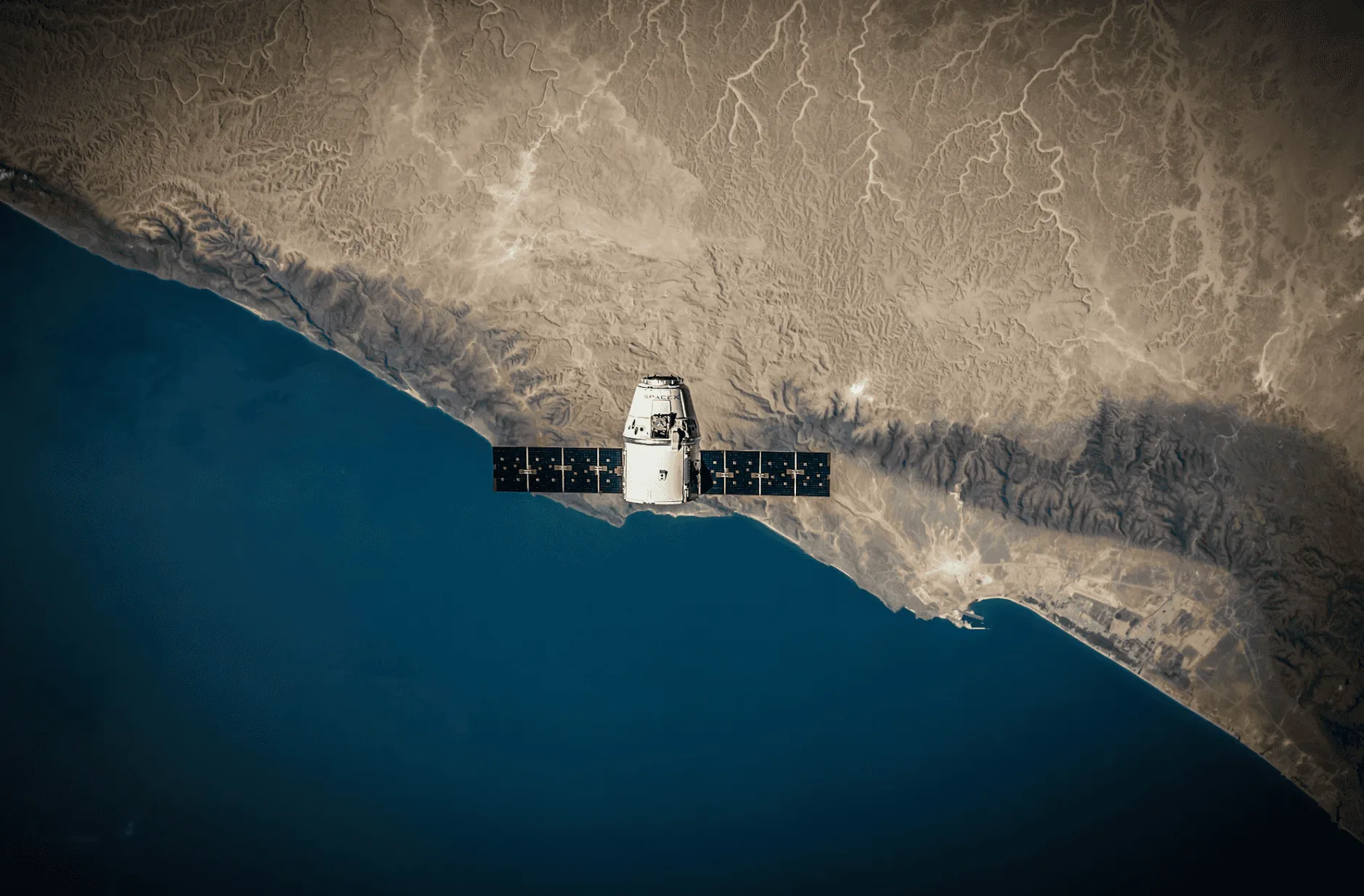
Today the expansion into space is driven above all by commercialisation. Commercial satellites now make up the vast majority of new launches (Harrison, 2024), and SpaceX alone operates more than 60 per cent of all active satellites (Abels, 2024, p. 859). Since almost every space technology can serve both civilian and military ends (Porras, 2019, p. 10), this shift has direct security consequences. The spatial, legal and strategic conditions under which conflicts begin, escalate and are fought are changing as a result (OECD, 2022; Hybrid CoE, 2023; Nötzold, 2024).
One consequence is that war depends less on clear front lines and fixed territory. Strategic advantage now rests heavily on information flows, robust communications, critical infrastructure and the ability to act quickly. Control over data, connectivity and space-based services can matter as much as control over ground (Kostenko & Manzhula, 2025).
The Deterritorialisation of the Battlefield
Our traditional picture of war is rooted in terrestrial thinking. Territory, borders, distance and position have long been the core categories of strategy. Schmitt made this link explicit. For him, every political order is bound to a concrete spatial order, a unity he called Ordnung und Ortung (Schmitt, 1997). Whoever orders a space decides which law applies within it and, in the last resort, who counts as friend and who as enemy (Schmitt, 1995, p. 87). Space does not fit this logic. It lacks the familiar reference points of land warfare, yet what happens there has direct effects on the ground.
Schmitt already observed that the modern state can no longer protect its population by sealing off its territory, as the lord of a castle once did by raising the drawbridge (Schmitt, 1995, p. 72). Satellites take this development much further. Space systems extend military reach. Communications, navigation and intelligence, surveillance and reconnaissance (ISR) satellites allow armed forces to observe and act far beyond where their troops are physically present (Hays & Wirtz, 2024). Ukraine illustrates this. Its armed forces built command-and-control systems on Starlink that combine drone, satellite and radio data into real-time maps of enemy positions (Daly, 2025). According to RUSI, Ukrainian drones accounted for an estimated 70 per cent of damaged and destroyed Russian systems in the third year of the war (Watling & Reynolds, 2025, p. 10).
Holding ground now goes hand in hand with access to the orbital and digital infrastructure that makes operations on the ground possible (Hybrid CoE, 2023).
Technological Change: Cyber Operations and Soft-Kill Effects
The character of force is changing too. Physical destruction still matters, but digital and electronic means are gaining weight, especially when space infrastructure is the target (Congressional Research Service [CRS], 2025).
Space systems are sensitive nodes in larger civilian and military networks. A successful attack on one of them can have effects far beyond the satellite or ground station itself (OECD, 2022; Schulze, 2023). The opening hours of the war showed this clearly. On 24 February 2022, about an hour before Russian ground forces crossed the border, a cyberattack disabled the KA-SAT network operated by the US company Viasat, which Ukrainian authorities and armed forces relied on for communications (EUREPOC, 2023). The attack did not stop at Ukraine’s borders. In Germany, the wind turbine manufacturer Enercon lost remote access to around 5,800 turbines. Because civilian and military users share the same infrastructure, such systems are attractive targets even for an attacker who wants to avoid physical destruction (Boschetti et al., 2022; Kostenko & Manzhula, 2025).
This is where soft-kill capabilities come in. Instead of destroying a satellite and creating debris, an actor can try to degrade, disrupt or manipulate how it works. Typical methods are jamming communication or navigation signals, spoofing navigation data, interfering with ground stations or temporarily blinding optical sensors. Their tactical appeal is obvious: they are often reversible, harder to detect and produce no lasting debris (CRS, 2025; CSIS, 2022).
Speed adds another problem. Military systems are becoming more automated, and the time available for decisions is shrinking. In a crisis, technical reactions and escalation can outpace political deliberation. Escalation is not inevitable as a result, but the risk grows that a minor technical incident is misread and spirals beyond its original scope (CSIS, 2025).
The Blurring of War and Peace
All this puts pressure on familiar categories. The line between war and peace, and between military and civilian spheres, is getting harder to draw. Much of what shapes the strategic environment happens below the threshold of open war (Hybrid CoE, 2023).
Cyber operations are the prime example. Attribution is difficult, and it remains disputed when a cyber operation counts as an armed attack. Attackers may therefore expect little immediate retaliation, which lowers the bar for action (CSIS, 2022; CRS, 2025). The legal framework of space itself offers little resistance. Under the Outer Space Treaty, outer space is not subject to national appropriation (United Nations, 1967, Art. II; Auswärtiges Amt, 2024), yet the treaty has no real enforcement mechanism. As a former member of the Bundeswehr Space Command put it, in space “there is no one who says stop” (personal communication, August 11, 2025). This is not a permanent state of war. It is, however, an environment in which competition and coercion continue even without a declared conflict.
New Actors Beyond the State
The idea of war as a clash between sovereign states is also being challenged. Non-state actors may try to carry conflicts into space, producing forms of irregular confrontation that fit none of the old categories of front lines, uniforms and clear responsibility (Hybrid CoE, 2023). Schmitt anticipated this possibility. He speculated that the partisan (as a non-state, yet politically motivated actor), in his final stage of development, might become a “cosmo-partisan” who controls parts of outer space or plays a decisive role in their control (Schmitt, 1995, p. 82).
Privatisation, meanwhile, has become a defining feature of space. States no longer control this domain alone. Private companies provide communications, Earth observation, launches and data analysis, and in wartime these services can become militarily decisive. Ukraine shows this clearly (Fedorov, 2022). Imagery providers such as Maxar, Planet Labs and ICEYE supplied data for intelligence and for documenting the war (ICEYE, 2024; Platt, 2024; Belfer Center, 2023).
Closing Thought
Taken together, these developments call for a broader understanding of strategy. Military power still counts, but it is increasingly tied to time, information, connectivity and the protection of space infrastructure. Schmitt’s link between order and space has not disappeared; it has moved into orbit, where states now share control with private companies. As space becomes more central to both civilian life and military operations, future conflicts will likely be shaped as much by networks, data flows and dependencies as by geography and territory (OECD, 2022; Hybrid CoE, 2023).
- Abels, J. (2024). Private infrastructure in geopolitical conflicts: The case of Starlink and the war in Ukraine. European Journal of International Relations. https://doi.org/10.1177/13540661241260653
- Auswärtiges Amt. (2024, September 24). Weltraumrecht. https://www.auswaertiges-amt.de/de/aussenpolitik/regelbasierte-internationale-ordnung/voelkerrecht-internationales-recht/einzelfragen/weltraumrecht
- Belfer Center. (2023). Starlink and the Russia-Ukraine war: A case of commercial technology and public purpose. Harvard Kennedy School. https://www.belfercenter.org/publication/starlink-and-russia-ukraine-war-case-commercial-technology-and-public-purpose
- Boschetti, N., Gordon, N., & Falco, G. (2022). Space cybersecurity lessons learned from the ViaSat cyberattack. https://www.researchgate.net/publication/363558808_Space_Cybersecurity_Lessons_Learned_from_The_ViaSat_Cyberattack
- Center for Strategic and International Studies (CSIS). (2022, June 14). Counterspace weapons 101. Aerospace Security Project. https://aerospace.csis.org/aerospace101/counterspace-weapons-101/
- Center for Strategic and International Studies (CSIS). (2025, September 16). Extending the battlespace to space. https://www.csis.org/analysis/chapter-8-extending-battlespace-space
- Congressional Research Service (CRS). (2025). Counterspace operations (IN12420). https://www.congress.gov/crs_external_products/IN/HTML/IN12420.web.html
- Daly, J. (2025, March 18). How Starlink keeps Ukraine’s military online and ahead in battle. UNITED24 Media. https://united24media.com/war-in-ukraine/how-starlink-keeps-ukraines-military-online-and-ahead-in-battle-6797
- EUREPOC. (2023). Major cyber incident: KA-SAT 9A. European Repository on Cyber Incidents. https://eurepoc.eu/de/publication_de/major-cyber-incident-ka-sat-9a/
- Fedorov, M. [@FedorovMykhailo]. (2022, February 26). @elonmusk, while you try to colonize Mars - Russia try to occupy Ukraine! [Post]. X. https://x.com/FedorovMykhailo/status/1497543633293266944
- Harrison, T. (2024). Building an enduring advantage in the third space age. American Enterprise Institute. https://www.aei.org/research-products/report/building-an-enduring-advantage-in-the-third-space-age/
- Hays, P. L., & Wirtz, J. J. (2024). Enabling national security through space: Intelligence and communications. In S. M. Pekkanen & P. J. Blount (Eds.), The Oxford handbook of space security. Oxford University Press. https://doi.org/10.1093/oxfordhb/9780197582671.013.39
- Hybrid CoE. (2023). The space domain and the Russo-Ukrainian war (Hybrid CoE Working Paper No. 21). The European Centre of Excellence for Countering Hybrid Threats. https://www.hybridcoe.fi/wp-content/uploads/2023/01/20230109-Hybrid-CoE-Working-Paper-21-Space-and-the-Ukraine-war-WEB.pdf
- ICEYE. (2024, July 7). ICEYE strengthens cooperation with the Ministry of Defense of Ukraine on space defense. https://www.iceye.com/newsroom/press-releases/iceye-strengthens-cooperation-with-the-ministry-of-defense-of-ukraine
- Kostenko, I., & Manzhula, A. (2025). From space to the battlefield: Ethical and legal aspects of the use of satellite technologies in the Russian-Ukrainian war. Philosophy and Cosmology, 34, 4–43. https://doi.org/10.29202/phil-cosm/34/1
- Mouffe, C. (2005). On the political. Routledge.
- Müller, J.-W. (2003). A dangerous mind: Carl Schmitt in post-war European thought. Yale University Press.
- Nötzold, A. (2024). Die sicherheitspolitische Bedeutung von Weltraum und NewSpace im Ukraine-Krieg - Politische Implikationen für die militärische und kommerzielle Raumfahrtnutzung. SIRIUS - Zeitschrift für Strategische Analysen, 8(2), 202–221. https://doi.org/10.1515/sirius-2024-2004
- Organisation for Economic Co-operation and Development (OECD). (2022). How the war in Ukraine is affecting space activities. https://www.oecd.org/content/dam/oecd/en/publications/reports/2022/11/how-the-war-in-ukraine-is-affecting-space-activities_8fb979f7-abba-2022-en.pdf
- Platt, K. H. (2024, September 30). Planet’s astounding satellite images map Russian war crimes in Ukraine. Forbes. https://www.forbes.com/sites/kevinholdenplatt/2024/09/30/planets-astounding-satellite-images-map-russian-war-crimes-in-ukraine/
- Porras, D. (2019). Shared risks: An examination of universal space security challenges. United Nations Institute for Disarmament Research. https://unidir.org/files/publication/pdfs/shared-risks-an-examination-of-universal-space-security-challenges-en-775.pdf
- Schmitt, C. (1995). Theorie des Partisanen: Zwischenbemerkung zum Begriff des Politischen (4th ed.). Duncker & Humblot.
- Schmitt, C. (1997). Der Nomos der Erde im Völkerrecht des Jus Publicum Europaeum (4th ed.). Duncker & Humblot.
- Schulze, M. (2023). Cyber-Sicherheit im Weltraum: Verwundbarkeiten, Angriffsvektoren und Schutzmaßnahmen (SWP-Aktuell No. 4/2023). Stiftung Wissenschaft und Politik. https://www.econstor.eu/bitstream/10419/268790/1/1832560848.pdf
- United Nations. (1967). Treaty on principles governing the activities of states in the exploration and use of outer space, including the Moon and other celestial bodies. United Nations Office for Outer Space Affairs.
- Vad, E. (1996). Strategie und Sicherheitspolitik: Perspektiven im Werk von Carl Schmitt. Westdeutscher Verlag. https://doi.org/10.1007/978-3-322-85096-6
- Watling, J., & Reynolds, N. (2025). Tactical developments during the third year of the Russo-Ukrainian war. Royal United Services Institute. https://static.rusi.org/tactical-developments-third-year-russo-ukrainian-war-february-2205.pdf