The Rise of NewSpace.
From Myth to Astropolitics: How Society’s View of Space Changed
“First, outer space shaped our cultures and our imagination through belief in gods and religion. Then came the space race of the Cold War, with its innovations and exertions—hardly had we ventured out when we discovered new resources, opportunities, and strategic positions worth striving for. This is how we arrived in the age of astropolitics.” — Marshall, 2024, p. 23
The quotation from Marshall’s book The Geography of the Future aptly summarizes the key points of the underlying developments in society’s perception of outer space. Even if the portrayal is condensed, it essentially captures the chronology. However, the present article focuses less on the human fascination with space conveyed in Marshall’s book - even though this fascination certainly plays a role for visionaries in the commercial spaceflight sector such as Elon Musk or Jeff Bezos (cf. Stadler, 2022). Instead, this article will concentrate on political developments in the United States that contributed significantly to the emergence of today’s dominant commercial space sector.
The Sputnik Shock: A Security Wake-Up Call in the United States
In the midst of the Cold War, the Soviet Union succeeded in placing Sputnik 1, the first artificial satellite, into Earth orbit. In the context of the race to space, this event was perceived as a technological and strategic triumph for Moscow and caused considerable security-policy alarm in the United States (cf. Lule, 1991). The so-called Sputnik shock threw Western intelligence services and the media into turmoil, as it not only suggested the Soviet Union’s technological superiority but also represented a danger in view of the newly demonstrated range of Soviet rockets (cf. ESA, 2017). The Soviet Union implied that it might now potentially be capable of transporting nuclear warheads over long distances.
NASA’s Founding: Rapid Response and Ideological Power Projection
Facing this threat, the U.S. government came under pressure to formulate a rapid response, which in 1958 under President Eisenhower led to the founding of NASA (cf. NASA, 2023, para. 1). Yet NASA’s establishment was not merely an immediate security-policy reaction to the Soviet success with Sputnik 1; it also served as an ideological demonstration of U.S. power (cf. Neuneck, 2022). It marked the starting signal for costly developments in space technology, closely linked to geopolitical tensions and the arms race of the late 1950s, and exclusively dominated by the state.
After the Cold War: Internationalization, Budget Pressure, and Reform Needs
With the end of the Cold War, the political and military pressure that had previously driven the arms race in space largely disappeared. At the same time, spaceflight became increasingly international, while the United States began to critically question the appropriateness of its enormous national space budget. The high costs and considerable time required for rocket launches bore no reasonable economic relationship, and state-run production facilities had few incentives to work more cost-efficiently or innovatively (cf. Berger, 2022). This dry spell was also recognized by then U.S. President Barack Obama. In response to persistent problems in the public space sector - such as fluctuating budgets, political neglect, outdated technology, and the lack of a clear vision - he presented a very clear solution in a landmark announcement in 2010 at the Kennedy Space Center: in the future, cooperation with the private sector should be strengthened. The excessively expensive government Space Shuttle program would be discontinued and replaced by private, more cost-effective alternatives, in the hope that greater competition, entrepreneurial dynamism, and new approaches would make spaceflight more efficient and capable (cf. Obama, 2010, para. 10 ff.).
Within NASA and in political circles, this change of course initially met with skepticism. Many feared that government control over central space tasks could be lost:
“I recognize that some have said it is unfeasible or unwise to work with the private sector in this way” (Obama, 2010, para. 17).
These efforts were by no means new: with the aim of benefiting in the future from privately created transport capacities, NASA began as early as 2006 to support private companies in developing their own rocket and spacecraft systems (cf. Lindenmoyer, 2014). The President’s speech was therefore less a radical new beginning than an official starting signal for actors who had been working toward this moment for years. In particular, SpaceX was among the most promising government partners from the outset, as over the years - alongside competitors such as Orbital Science or Rocket Lab - it demonstrated clear progress within the framework of government funding programs. In 2012, Elon Musk became the first private entrepreneur to carry out a successful demonstration flight to the International Space Station (ISS) with his Falcon 9 rocket. With this success, SpaceX ultimately gained NASA’s trust and, as the first commercial company, received a contract for twelve orbital transport flights with a total value of 1.6 billion U.S. dollars (cf. NASA, 2013).
A Cost Revolution: Launch Costs in Comparison
As can be seen in Figure 1, supporting the commercial sector appears at first glance to be a major success. If one compares the launch costs per kilogram of payload for Elon Musk’s commercial, competition-driven rockets (Falcon 9 and, in the future, Falcon Heavy) with those of government launch systems, it becomes clear that the former are so markedly cheaper - both compared to the European Ariane 44 and 5G rockets and especially compared to the former government Space Shuttle - that one can speak of a cost revolution.
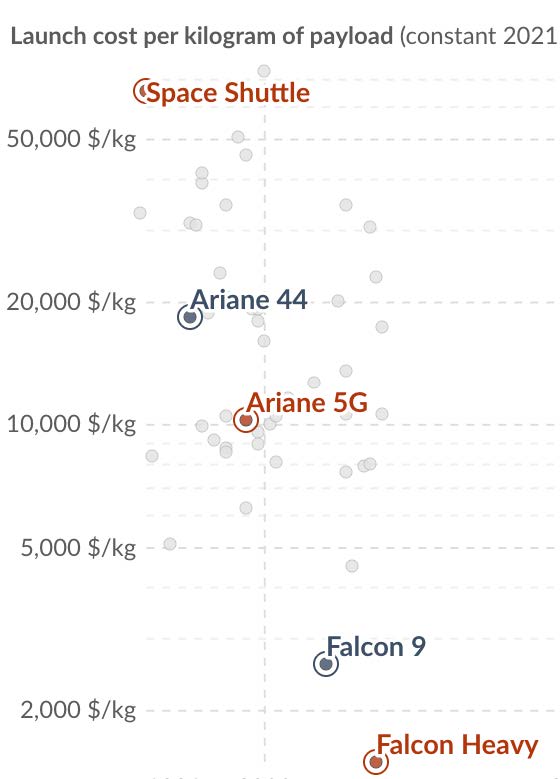
Figure 1: Launch cost per kilogram of payload
(CSIS Aerospace Security Project, 2022)
In addition to NASA, other actors also benefited from the reduced launch costs. Commercial companies had already previously operated small satellites in low Earth orbit for Earth observation, weather monitoring, or communication services. However, their access options were long strongly limited, as they generally depended on state-developed launch systems from Europe, Russia, India, or the United States - associated with restrictive procurement rules and high prices (cf. Skaar, 2007). This was now set to change. The new opportunities created by state support for the private sector gave rise to a dynamic market for transport services to space, driven by the growing connectivity needs of modern society. This triggered a noticeable trend of investment and company formation in the United States: startups and investors entered the sector, and companies such as Blue Origin (Jeff Bezos), Rocket Lab, and the United Launch Alliance (ULA) used the tailwind - including government funding and procurement programs—to compete with SpaceX for market share.
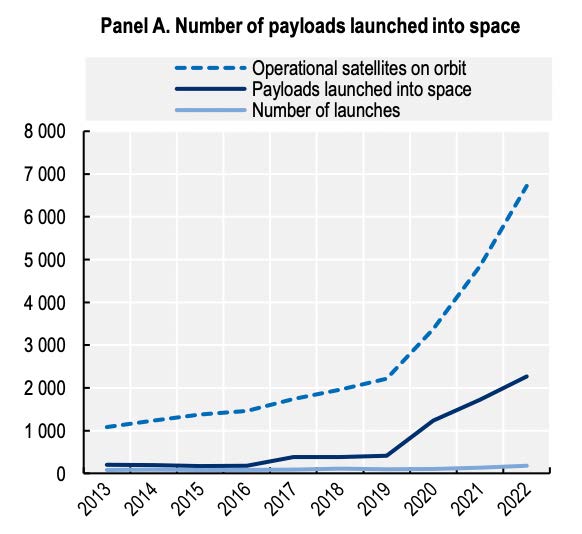
Figure 2: Number of payloads launched into space
(OECD, 2023)
Satellite Boom and Dual Use: Why the Trend Matters
Figure 2 shows the sharp increase in the number of operational satellites in orbit in recent years. Driven by rising demand for satellite services (Industry 4.0, autonomous driving, and AI) and a competition-driven private sector aiming to make access to space as easy as possible, it is now possible to book launch capacity via an online portal using a credit card - for example with companies such as Rocket Lab, which transports satellites into space as a kind of “freight forwarder” (cf. Rocket Lab – Book My Launch, 2025). Considering that most satellites are dual-use capable, the relevance of this development becomes clear (cf. Dunlap, 2023).
References:
Stadler, C. (2022, March 22). Elon Musk and Jeff Bezos were inspired by sci-fi — and so should you. Forbes. Retrieved October 27, 2025, from https://www.forbes.com/sites/christianstadler/2022/03/22/elon-musk-and-jeff-bezos-were-inspired-by-sci-fi-and-so-should-you/
Marshall, T. (2024). The Geography of the Future: How the Struggle for Dominance in Space Will Change Our World (L. W. Wolff, Trans.). dtv. (Original work published 2023)
Lule, J. (1991). Roots of the Space Race: Sputnik and the Language of U.S. News in 1957. Deleted Journal, 68(1–2), 76–86. https://doi.org/10.1177/107769909106800109
European Space Agency (ESA). (2017). Sputnik—More Than Just a Satellite. https://www.esa.int/Space_in_Member_States/Germany/Sputnik_-_mehr_als_bloss_ein_Satellit (Retrieved July 25, 2025)
NASA. (2013, November). NASA hails success of commercial space program—private space station resupply underway, plans readied for astronauts. https://www.nasa.gov/news-release/nasa-hails-success-of-commercial-space-program-private-space-station-resupply-underway-plans-readied-for-astronauts/ (Retrieved October 4, 2025)
NASA. (2023, July 26). 65 years ago: The National Aeronautics and Space Act of 1958 creates NASA. NASA. https://www.nasa.gov/history/65-years-ago-the-national-aeronautics-and-space-act-of-1958-creates-nasa/
Neuneck, G. (2022, February 16). An Arms Race in Space? Federal Agency for Civic Education (bpb). https://www.bpb.de/shop/zeitschriften/apuz/293690/wettruesten-im-all/
Berger, E. (2022, May 3). NASA chief says cost-plus contracts are a “plague” on the space agency. Ars Technica. https://arstechnica.com/science/2022/05/nasa-chief-says-cost-plus-contracts-are-a-plague-on-the-space-agency/
Obama, B. (2010, April 15). Press Release: Remarks of President Barack Obama at the Kennedy Space Center—As Prepared for Delivery. The American Presidency Project. Retrieved October 27, 2025, from https://www.presidency.ucsb.edu/documents/press-release-remarks-president-barack-obama-the-kennedy-space-center-prepared-for
Lindenmoyer, A. (2014). Commercial Orbital Transportation Services: A new era in spaceflight (NASA/SP-2014-617). National Aeronautics and Space Administration. https://www.nasa.gov/wp-content/uploads/2016/08/sp-2014-617.pdf
CSIS Aerospace Security Project. (2022). Cost of space launches to low Earth orbit. Our World in Data. https://ourworldindata.org/grapher/cost-space-launches-low-earth-orbit?zoomToSelection=true&time=1975..latest&country=Space+Shuttle~Falcon+9~Falcon+Heavy~Ariane+44~Ariane+5G (Retrieved August 17, 2025)
Skaar, R. (2007). Commercialisation of space and its evolution. ESPI Report 4. ESPI—European Space Policy Institute. https://www.espi.or.at/wp-content/uploads/espidocs/Public%20ESPI%20Reports/espi_report_4.pdf